




Enhancing EU-Kazakhstan cooperation for a sustainable future

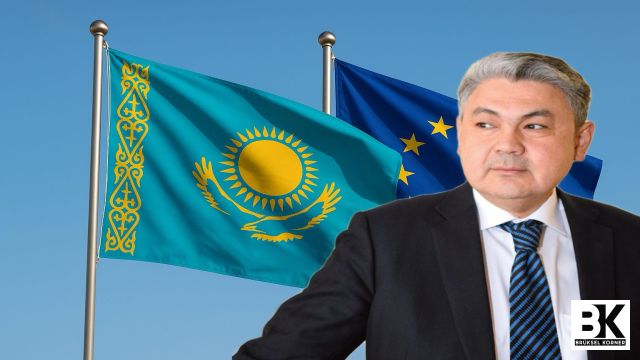
By Yermek Kosherbayev, Minister of Foreign Affairs, Republic of Kazakhstan
The opinions expressed in this article are those of the author and do not represent in any way the editorial position of Euronews.
Kazakhstan and the EU share a long-term interest in stable, resilient and predictable supply chains that underpin economic growth and deliver the technologies needed for a cleaner future, Foreign Affairs Minister Yermek Kosherbayev writes in an opinion article for Euronews.
This December marks 10 years since Kazakhstan and the European Union signed the Enhanced Partnership and Cooperation Agreement (EPCA), a milestone that confirmed our shared commitment to a broad and forward-looking partnership.
Over the past decade, cooperation has expanded across political dialogue, security, investment, education, and connectivity. With more than €200 billion invested since 2005, the EU is now Kazakhstan’s largest trade and investment partner.
Today, as ever, our relationship is shaped by a shared commitment to the UN Charter and its principles, and a shared understanding that many of the global challenges can only be addressed through deeper collaboration between Europe and its close and reliable partners.
One such challenge sits at the core of Europe’s long-term growth: securing the materials and technologies essential for the green and digital transitions. Europe’s dependence on a small group of suppliers for critical raw materials has become a defining question for its competitiveness.
Ensuring stable access to these inputs is no longer simply an industrial issue, it is a strategic one. It is in this context that Kazakhstan can play a meaningful role.
Kazakhstan is already part of the answer
The European Commission has emphasised that Europe must diversify its sources of critical raw materials. The question facing European policymakers today is how to mitigate the risk while maintaining momentum on the Green Deal.
Kazakhstan is already part of the answer. In 2024, bilateral trade with the EU reached $48.8 billion, and more than 80% of Kazakhstan’s oil exports are directed to European markets.
Looking ahead, we see an opportunity to build more secure and diversified critical minerals supply chains for Europe, an area where our resources and experience are directly relevant.
The past decade has shown what this partnership can achieve. The decade ahead must be defined by implementation: strategic projects, stronger value chains, modernised infrastructure and deeper technological cooperation.
The EU’s Critical Raw Materials Act highlights the scale of the challenge. By 2030, Europe aims to extract, process, and recycle far more of its needs while limiting dependence on any single external supplier.
Recent disruptions have shown how easily supply chains can be strained by geopolitical tensions or logistical shocks. Demand for copper, graphite, rare earth elements, manganese, titanium and other transition minerals continues to grow at a pace far exceeding global supply.
Kazakhstan is one of the few countries that can contribute to filling this gap. According to the EU’s own assessments, Kazakhstan can supply 21 of the 34 raw materials the EU considers critical, including several categorised as strategic. Our Sarytogan graphite project is included on the EU’s official list of Strategic Projects under the Critical Raw Materials Act.
The basis for this work is strong. More than 4,000 European companies operate in Kazakhstan today. Our 2022 Strategic Partnership MoU with the EU on critical raw materials, batteries, and renewable hydrogen has strengthened the EPCA’s economic pillar. The joint 2025–2026 Roadmap now sets clear priorities – from geological exploration to value-chain development and green hydrogen.
The task now is to turn this strong basis into practical results.

Turning shared challenges into shared strengths together
A first step is focusing jointly on a select number of high-impact projects. Expanding cooperation in key areas such as copper, manganese, titanium, rare earth elements and other essential minerals would help build a more diversified supply base for Europe and provide investors with clearer long-term visibility.
Building resilience also means moving beyond raw materials alone. Europe’s processing and refining goals will require trusted partners with both capacity and geographic reach. Kazakhstan has the resources to support this shift, and expanding cooperation in selected areas of processing would help create a more diversified and predictable supply base for Europe.
Transport and logistics matter, too. Critical materials need sustainable and secure routes, and the Trans-Caspian International Transport Route – known as the Middle Corridor – has already become an important link between Central Asia and Europe.
With more than €10 billion in commitments from the European Commission and international financial institutions, the route is gaining efficiency and cutting transit times. Continued investment in infrastructure, rail capacity and digital systems will further strengthen this corridor and help de-risk Europe’s clean-energy supply chains.
Innovation and skills must advance in step. Secure supply chains depend on technology and expertise, not just raw materials. Kazakhstan already participates in Horizon Europe and Erasmus+, and with the visa facilitation for Kazakh citizens expected in the foreseeable future, deeper cooperation in geological surveying, battery recycling, low-impact extraction and green hydrogen would support Europe’s climate goals while accelerating Kazakhstan’s industrial upgrade.
As we mark 10 years since the Enhanced Partnership and Cooperation Agreement, the direction is clear: Kazakhstan and the EU share a long-term interest in stable, resilient and predictable supply chains that underpin economic growth and deliver the technologies needed for a cleaner future.
The past decade has shown what this partnership can achieve. The decade ahead must be defined by implementation: strategic projects, stronger value chains, modernised infrastructure, and deeper technological cooperation.
Europe’s transition will ultimately depend on securing the materials that underpin future industries. With the right choices, both sides can build a stronger and more resilient partnership. Kazakhstan stands ready to work with the European Union to turn shared challenges into shared strengths.
Yermek Kosherbayev serves as Minister of Foreign Affairs of the Republic of Kazakhstan.
Yorum Yazın