
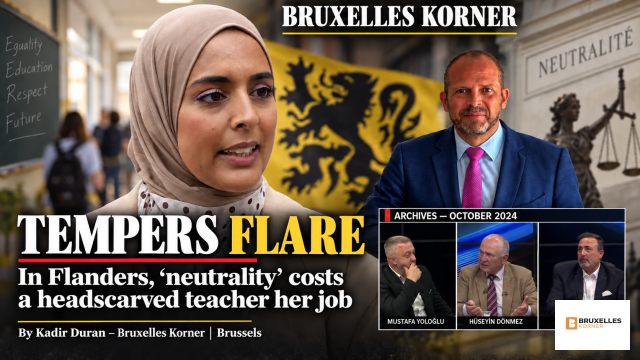





Tempers flare: in Flanders, “neutrality” costs a headscarf-wearing teacher her job
https://youtu.be/v4lTNFHcahY?is=Y5D3haa3WSubbUgr
Hadija Amajoud, a permanently appointed teacher in provincial special education, has been dismissed after refusing to remove her headscarf. Nearly two years after the issue was debated on Avrupa TV, the concerns expressed at the time have become a reality. Will this dismissal be the first in a long series?
By Kadir Duran – Bruxelles Korner | Brussels
14 September 2026

Tempers are flaring. This time, behind the abstract debate over neutrality, there is a human face, a career and a sense of financial security being shattered.
The Province of East Flanders has decided to dismiss Hadija Amajoud, a teacher at the Kiempunt Campus special primary school in Assenede. Her offence: refusing to remove the headscarf she had already been wearing when she was first employed.
“I am losing not only my job, but also my income, my security and my permanent appointment. Everything I had built suddenly disappeared,” she said following the announcement of her dismissal.
Behind this individual decision lies a much broader question: how far can a public authority go in the name of neutrality? More importantly, does this neutrality genuinely protect all citizens, or is it gradually becoming a political instrument targeting some convictions more than others?
A debate we raised as early as October 2024
Bruxelles Korner addressed this issue in October 2024 during a programme broadcast on Avrupa TV with Hüseyin Dönmez and Mustafa Yoloğlu, then a Vooruit municipal councillor.
The discussion already focused on the headscarf, the position of the teachers concerned and political policies liable to restrict the expression of religious beliefs in schools and public administrations.
At the time, Mustafa Yoloğlu stressed that elected representatives from diverse backgrounds had a responsibility to defend, within their own parties, the concerns of the citizens who had placed their trust in them. He argued that decisions affecting culture, religion or individual freedoms had to be discussed and, where necessary, challenged from within political party structures themselves.
The possible abolition or reduction of religious education classes was also discussed. Concerns were already being expressed about the professional future of hundreds of teachers responsible for Islamic religious education.
Nearly two years later, the debate is no longer theoretical.
East Flanders has now put into practice a policy that turns a dress-code rule into grounds for dismissal.
A teacher whose professional performance was never questioned
Hadija Amajoud had been working in provincial education since 1 September 2022. She speaks Dutch fluently and, according to publicly available information, her teaching performance had never been the subject of a negative evaluation.
She was even granted permanent appointment status on 1 January 2024.
The headscarf was therefore nothing new: she was already wearing it when she took up her position. It was not the teacher who changed, but the regulations.
On 27 June 2024, the province amended the rules applying to its staff. The new framework now prohibits visible religious, philosophical or ideological symbols, with an exception for teachers who provide recognised religious or non-confessional ethics courses.
An initial disciplinary procedure had nevertheless failed. The provincial disciplinary committee recommended that the case be closed, finding that the code of conduct in force at the time could not be applied to the teacher and that no disciplinary offence had been established.
The province eventually closed the procedure without imposing a sanction in October 2024.
In the meantime, however, the rules were strengthened. After several proceedings, the sanction has finally fallen: dismissal.
The Flemish socialist trade union ACOD, the Dutch-speaking counterpart of the CGSP, has announced that it will challenge the decision before the Appeals Chamber in Brussels.
“We will continue to oppose this for as long as possible,” trade union representative Kristof Bruyland said.
Neutrality: a legal principle or politics’ magic word?
Vooruit, the N-VA and the MR regularly invoke neutrality. It appears to have become the magic word used to justify almost any restriction on religious expression.
Yet neutrality has no single, universally accepted definition.
There is a fundamental difference between the neutrality of a public service and the complete erasure of every public employee’s personal convictions. Can a teacher carry out her duties impartially while wearing a religious symbol? Or should her appearance alone be considered sufficient to compromise the neutrality of the institution?
Hadija Amajoud defends the first interpretation. She believes that the provincial authority is applying a “purely political” conception of neutrality.
The question must be asked: did this teacher ever attempt to impose her religion on her pupils? Did she refuse to teach the prescribed curriculum? Had any complaints been made about her professional conduct?
At this stage, the publicly available facts suggest that the dispute is based solely on the visible wearing of the headscarf.
Neutrality should not mean judging a person by their appearance. It should mean determining whether they treat pupils equally, respect their freedom of conscience and properly fulfil their educational responsibilities.
What the Belgian Constitution actually protects
Belgium is not constitutionally founded upon an exclusionary form of secularism comparable to the French model. Its system rests upon a balance between the neutrality of public authorities, religious freedom, pluralism and equality.
Article 19 of the Belgian Constitution guarantees:
“Freedom of worship, its public practice and freedom to demonstrate one’s opinions on all matters […]”
This freedom includes the right to believe, not to believe, to change one’s convictions and to manifest one’s religion, individually or collectively.
Articles 10 and 11 also establish equality before the law and prohibit discrimination. Article 20 stipulates that no one may be compelled to participate in the acts or ceremonies of a religion. Article 24, meanwhile, requires education organised by the Communities to respect the philosophical, ideological and religious views of parents and pupils.
These rights are not absolute. Religious freedom may be subject to restrictions, particularly in the workplace. Such restrictions must, however, pursue a legitimate objective, be clearly established, be applied consistently and remain proportionate.
In other words, simply invoking neutrality is not enough. It must still be demonstrated why a competent teacher’s headscarf would pose a concrete threat to pupils, education or the impartiality of the public service. The constitutional and legal framework is explained in greater detail by the Belgian Senate and Unia.
Theo Francken applauds the decision
N-VA minister Theo Francken publicly welcomed the policy implemented in East Flanders. He recalled that in Lubbeek, where he served for many years as mayor, the principle of neutrality had already been introduced within the municipal administration, schools and childcare services.
According to Francken, the employees concerned either complied with the rules or chose to seek employment elsewhere. He considers visible religious symbols incompatible with the neutrality of public services and has congratulated the provincial officials who implemented this policy.
More controversial still is his interpretation of the headscarf. Theo Francken questions whether many young girls genuinely wear it voluntarily, presenting it as a religious—and sometimes ideological—code of conduct imposed collectively.
This generalisation is problematic. It amounts to assuming that women who wear headscarves are, by definition, incapable of deciding for themselves what to wear. They are supposedly being liberated, but the first step is to deny them the opportunity to speak in their own name.
The paradox is striking: in the name of women’s emancipation, a woman loses her job, her income and the career she had built.
A democratic decision does not end the legal debate
Supporters of the ban argue that it was adopted democratically. But a political majority cannot simply do whatever it wishes merely because it has enough votes.
In a state governed by the rule of law, democratic decisions remain subject to the Constitution, anti-discrimination legislation, European law and judicial review.
That is precisely the purpose of an appeal: to determine whether the measure pursues a legitimate objective and whether dismissal constitutes a proportionate response. The courts will also have to take into account the fact that the teacher was recruited and later permanently appointed while already wearing her headscarf.
The real question is therefore not merely whether a general ban may exist. It is whether rules may be changed in the middle of someone’s career and then used to deprive a permanently appointed teacher of her job when no professional shortcomings have been alleged against her.
Where are the elected representatives who promised to defend freedom?
During the 2024 election campaign, several parties that actively sought support from voters of immigrant backgrounds claimed that they would defend fundamental freedoms and combat discrimination.
During our October 2024 programme, the responsibility of elected representatives from these communities was clearly raised: once elected, would they genuinely be capable of defending these issues within their own parties? Or would their promises disappear when confronted with internal political power struggles?
Today, the question has returned with even greater urgency.
What do Vooruit’s elected representatives have to say? What do Flemish socialist leaders think of a decision targeting a teacher whose dismissal is being challenged by a socialist trade union? What is the MR’s position when it defends a restrictive conception of neutrality? How far does the N-VA intend to extend these prohibitions?
The voters concerned have the right to receive precise answers—not merely statements made during election campaigns.
The first dismissal—but certainly not the last?
Hadija Amajoud is believed to be the first teacher in Flanders to be explicitly dismissed for refusing to remove her headscarf. This case now establishes a political and administrative precedent.
Other public authorities may be tempted to adopt similar regulations. Other teachers, educators, municipal employees or administrative staff could soon be confronted with the same choice: remove their headscarf or lose their job.
That is where the real issue lies.
Today, it is Hadija Amajoud. Tomorrow, how many others will be affected? And the day after tomorrow, which other convictions or forms of individual expression will be deemed incompatible with a concept of neutrality whose definition changes according to the political majority in power?
A democracy is not measured solely by the will of the majority. It is also measured by its ability to protect the rights of minorities.
Neutrality should ensure that the state favours no particular belief. It should not become a pretext for erasing certain people from public life.
Hadija Amajoud has lost her job without her professional abilities ever being called into question. That is the heart of this case. Behind the grand principles and political rhetoric, a competent teacher has been deprived of her career because of an item of clothing connected to her religious convictions.
The sanction has fallen. The legal battle is beginning.
But one question continues to hang over the whole of Flanders: will Hadija Amajoud be the first—but not the last?
Yorum Yazın