
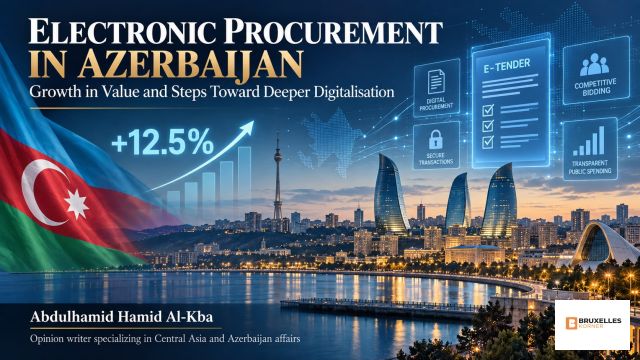





Electronic Procurement in Azerbaijan: Rising Value and the Next Stage of Digitalisation
Azerbaijan’s electronic public procurement rose by 12.5% in value during the first seven months of 2026. The figures point to greater digitalisation and budget efficiency—but also underline the need for broader competition and stronger SME participation.
Abdulhamid Hamid Al-Kba
Opinion writer specializing in Central Asia and Azerbaijan affairs

When public procurement figures point to a digital shift, they reveal far more than an administrative trend. They reflect a change in how public money is managed, how contracts are awarded and how widely the market is opened to competition.
Between January and July 2026, Azerbaijan recorded a 12.5% increase in the value of electronic procurement compared with the same period a year earlier, according to data from the State Agency for Antimonopoly and Consumer Market Control under the President of the Republic of Azerbaijan.
The figures at a glance
2.34 billion manat in electronic procurement during January–July 2026—approximately $1.37 billion;
4,596 electronic procedures, compared with 4,582 during the same period in 2025;
12.5% growth in total value, while the number of procedures increased by only 0.3%;
an average of 3.5 participants in open tenders.
In the corresponding period of 2025, electronic procurement was worth 2.08 billion manat, or approximately $1.2 billion. The contrast is significant: the number of procedures remained almost stable, but their combined value rose markedly.
Larger contracts are moving online
This divergence suggests that electronic procurement is increasingly being used for higher-value contracts rather than merely generating a greater number of transactions. It indicates that digital platforms are becoming more central to the management of substantial public expenditure.
The average of 3.5 participants per open tender also points to a meaningful degree of competition. Yet it should not be treated as an endpoint. The figures leave room for a wider supplier base, particularly among small and medium-sized enterprises.
The Agency considers the rise in electronic procurement a sign of deeper digitalisation, improved accessibility and positive momentum in the competitive environment. Its Deputy Head, Mirza Mirzayev, has likewise stated that the digital transformation of public purchasing continues to advance.
A longer-term transformation
The trend did not begin in 2026. According to Mirzayev, the total volume of public procurement in 2025 was 1.6 times higher than in 2020. Over the same period, the number of electronic procedures increased 4.3-fold, while their combined value rose 5.3-fold.
Electronic procurement reportedly generated savings equal to 17.9% of estimated contract values for the state budget. This is one of the clearest indications that digital procedures can deliver benefits beyond administrative convenience: stronger price competition and measurable economic efficiency.
The momentum continued during the first half of 2026, when nearly 3,500 electronic procedures were conducted with a total value of 1.7 billion manat—approximately $1 billion—and an average of 3.5 participants in open tenders.
Transparency, efficiency and access
Moving from paper-based procedures to electronic platforms can strengthen transparency, reduce opportunities for unjustified interference and make tenders more accessible to companies. It can also improve traceability, standardise procedures and reinforce oversight of public spending.
For businesses, digitalisation may lower the administrative barriers associated with participation in government tenders. For the state, it can broaden the pool of suppliers and improve value for money.
However, digitalisation alone does not automatically guarantee effective competition. Its impact depends on how the platform is designed, how accessible it is to suppliers and how consistently procurement rules are applied.
The remaining challenge: deeper competition
The modest increase in the number of procedures, compared with the sharper rise in value, may indicate that progress is concentrated in larger contracts while some smaller-scale purchasing remains less visible on the electronic platform.
Similarly, an average of 3.5 bidders is encouraging but still highlights the need to attract more suppliers. Greater SME participation would help prevent excessive concentration, improve regional access and make the procurement market more inclusive.
The next stage therefore requires attention to several factors:
ease of access and use for businesses;
stable and secure digital infrastructure;
supplier confidence in the fairness of procedures;
effective oversight as transaction volumes grow;
timely completion of procurement processes;
wider participation across sectors and regions.
From numerical growth to institutional maturity
The figures for the first seven months of 2026 present a broadly positive but balanced picture. Azerbaijan is taking clear steps toward the digitalisation of public procurement, and the rise in contract value confirms that electronic platforms are becoming an increasingly important channel for government spending.
Yet sustainable transformation requires more than rising totals. It depends on broader participation, consistent transparency across contracts of every size and the ability to extend digital procurement across different sectors and regions.
The direction is upward. The real test will be whether Azerbaijan can convert this momentum into a procurement system that is not only more digital, but also more competitive, inclusive, efficient and trusted over the long term.
Yorum Yazın