
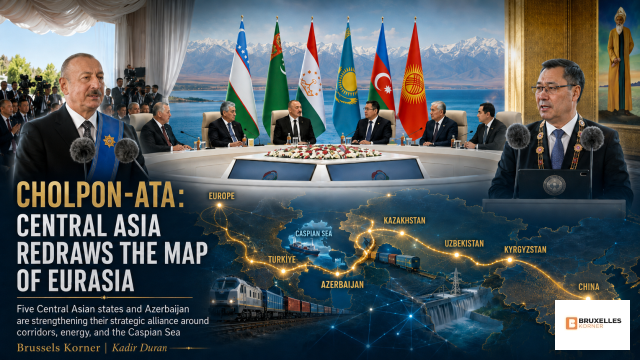





Cholpon-Ata Declaration Signed as Central Asian Leaders and Azerbaijani President Deepen Regional Integration
From Central Asia to the South Caucasus, the Cholpon-Ata meeting signals the emergence of a broader Eurasian cooperation architecture built around connectivity, energy, trade and strategic autonomy.
Bruxelles Korner | Kadir Duran
Cholpon-Ata, Kyrgyz Republic – 31 July 2026

A significant new chapter in Central Asian regional cooperation was opened on the shores of Lake Issyk-Kul as the leaders of the five Central Asian republics and Azerbaijan gathered in the Kyrgyz resort city of Cholpon-Ata for an informal Consultative Meeting.
Hosted by President of the Kyrgyz Republic Sadyr Zhaparov, the meeting brought together Kazakhstan’s President Kassym-Jomart Tokayev, Uzbekistan’s President Shavkat Mirziyoyev, Tajikistan’s President Emomali Rahmon, Turkmenistan’s President Serdar Berdimuhamedov, and Azerbaijani President Ilham Aliyev.
The participation of Azerbaijan is increasingly significant. What began as a mechanism for dialogue among the five Central Asian states is gradually developing into a wider geopolitical platform connecting Central Asia with the South Caucasus and, through the Caspian Sea, Türkiye and Europe.
Uzbekistan’s presidency described Azerbaijan’s participation as elevating the cooperation format to a “macro-regional” level, potentially creating a broader development space linking Central Asia, the South Caucasus and Afghanistan.
Cholpon-Ata Declaration adopted
The informal summit concluded with the adoption of the Cholpon-Ata Declaration, reflecting the participating states’ intention to deepen political dialogue, regional connectivity, economic cooperation and coordination on shared challenges.
The declaration comes at a moment when Central Asia is undergoing a profound geopolitical transformation.
For decades, relations among the states of the region were frequently complicated by unresolved borders, disputes over water resources, competing economic priorities and the geopolitical weight of larger external powers.
That picture is changing.
The settlement of several border disputes, the normalization of relations between Kyrgyzstan and Tajikistan, stronger trade links between neighbouring states and the multiplication of presidential summits have created a markedly different regional environment.
Central Asian governments are increasingly trying to define their interests collectively rather than exclusively through external powers.
Cholpon-Ata therefore represents more than another diplomatic meeting.
It reflects the emergence of Central Asia as a political region increasingly conscious of its own strategic weight.
Azerbaijan changes the geographical equation

Azerbaijan’s increasingly institutionalized participation deserves particular attention.
Geographically, Azerbaijan provides the natural bridge between Central Asia and the South Caucasus.
Economically, it occupies a pivotal position on the Trans-Caspian International Transport Route — commonly known as the Middle Corridor — linking China and Central Asia to the Caucasus, Türkiye and European markets.
For Kazakhstan, Uzbekistan, Kyrgyzstan and Turkmenistan, developing westward transport corridors has become particularly important as Eurasian trade routes diversify.
The Caspian Sea is therefore no longer simply a geographical barrier.
It is becoming a strategic junction.
The emerging architecture can increasingly be visualized as:
China → Central Asia → Caspian Sea → Azerbaijan → Georgia/Türkiye → Europe
In this configuration, Baku becomes an indispensable transport and logistics partner for Central Asian economies seeking diversified access to international markets.

China–Kyrgyzstan–Uzbekistan railway: a strategic corridor
President Zhaparov placed particular emphasis on transport connectivity.
Among the most important projects is the China–Kyrgyzstan–Uzbekistan railway, one of the most strategically significant infrastructure projects currently under development in Central Asia.
The railway is intended to establish a more direct transport connection between western China and Central Asia, before potentially connecting onward toward the Caspian Sea, the Middle East and Europe.
Its significance goes beyond commercial freight.
The project contributes to the gradual creation of an alternative Eurasian transport geography.
For Kyrgyzstan, historically disadvantaged by its mountainous terrain and limited railway network, the project could fundamentally alter the country's economic geography.
For Uzbekistan, it provides additional access toward China.
And at the broader Eurasian level, the railway may eventually complement the Middle Corridor linking Central Asia to Azerbaijan and Türkiye.

Energy security: Kambarata HPP-1
Energy cooperation constituted another major pillar of the discussions.
President Zhaparov highlighted the Kambarata-1 Hydropower Plant, being developed by Kyrgyzstan in cooperation with Kazakhstan and Uzbekistan.
The project is strategically important because Central Asia faces a complicated relationship between energy production, water management, population growth and climate change.
Kyrgyzstan and Tajikistan possess substantial upstream hydropower resources, while Kazakhstan, Uzbekistan and Turkmenistan have historically depended heavily on downstream water flows for agriculture.
Regional hydropower cooperation can therefore become either a source of competition or an instrument of integration.
The joint participation of Kyrgyzstan, Kazakhstan and Uzbekistan in Kambarata-1 suggests that the region increasingly prefers the latter approach.
If successfully implemented, such projects could transform water and energy from sources of interstate tension into foundations for regional cooperation.
Kyrgyzstan enters the UN Security Council
The Cholpon-Ata discussions also took place only weeks after a major diplomatic success for Bishkek.
On 3 June 2026, Kyrgyzstan was elected a non-permanent member of the United Nations Security Council for the 2027–2028 term, receiving 142 votes.
President Zhaparov subsequently thanked the Central Asian states for supporting the Kyrgyz campaign and said Bishkek intends to promote issues including international peace, conflict prevention, climate security, water resources and the concerns of small and developing states during its Security Council mandate.
This development could also provide Central Asia with additional diplomatic visibility at the United Nations.
Rather than presenting itself solely as an individual national representative, Kyrgyzstan has an opportunity to place regional concerns — particularly water security, mountains, climate change and connectivity — more prominently on the international agenda.

A common tourist visa?
Another notable proposal concerned tourism.
President Zhaparov renewed Kyrgyzstan’s call for greater coordination between Central Asian states, including the possibility of creating a unified regional tourist visa.
The idea is strategically logical.
International visitors rarely perceive Kazakhstan, Kyrgyzstan, Uzbekistan, Tajikistan and Turkmenistan solely as isolated destinations.
The Silk Road, the Tian Shan mountains, Samarkand and Bukhara, the deserts of Turkmenistan, Lake Issyk-Kul and Kazakhstan’s vast steppe form parts of a broader historical and geographical space.
A common or coordinated visa regime could eventually allow Central Asia to market itself as a single multidestination tourism region.
However, implementing such a project would require considerable coordination over border procedures, security databases, immigration policy and visa regulations.
It therefore remains an ambitious political objective rather than an immediately operational mechanism.
Climate, water and regional resilience
Climate change featured prominently in the regional agenda.
Central Asia is particularly vulnerable to rising temperatures, glacier retreat, desertification and growing pressure on water resources.
The problem is inherently transnational.
Rivers do not respect political borders, while the region’s energy and agricultural systems remain deeply interconnected.
This creates a compelling logic for joint policy.
Water management, renewable energy, hydroelectric infrastructure and environmental protection are consequently becoming central components of Central Asian diplomacy.
The emerging regional dialogue is therefore increasingly moving beyond traditional questions of sovereignty and border security toward more complex forms of shared governance.

From regional dialogue to strategic autonomy
The deeper significance of Cholpon-Ata lies in the concept of strategic autonomy.
Central Asian states do not appear to be replacing one geopolitical patron with another.
Instead, they are multiplying partnerships.
China remains crucial for infrastructure and trade.
Russia continues to retain deep economic, political, linguistic and security connections.
The European Union is expanding investment and connectivity partnerships.
Türkiye is strengthening political, commercial and cultural ties.
The Gulf states are becoming increasingly active investors.
And Azerbaijan is emerging as the essential Caspian bridge toward the South Caucasus.
This multi-vector diplomacy allows Central Asian capitals to increase their bargaining power while avoiding excessive dependence on any single external actor.
Regional integration reinforces that strategy.
The stronger their cooperation with one another, the greater their ability to negotiate collectively with China, Russia, Europe, Türkiye and other powers.

Central Asia and the South Caucasus are moving closer
Azerbaijan’s participation may ultimately prove one of the most consequential developments in this process.
The traditional geographical distinction between “Central Asia” and the “South Caucasus” is becoming less relevant in economic terms.
Transport corridors, energy infrastructure, ports, railways and digital networks are increasingly connecting the two regions.
Kazakhstan and Turkmenistan possess Caspian ports.
Azerbaijan provides access westward.
Georgia and Türkiye connect these networks to European markets.
Uzbekistan is rapidly industrializing and searching for diversified export routes.
Kyrgyzstan could gain new connectivity through the China–Kyrgyzstan–Uzbekistan railway.
The result is the gradual formation of an East–West Eurasian economic axis in which Central Asia is no longer merely an interior continental region but a transit and production hub linking major markets.

Avaza: the next stage
The diplomatic process will continue shortly.
The next Consultative Meeting of the Heads of State of Central Asia and Azerbaijan is scheduled for 8 October 2026 in Avaza, Turkmenistan.
Turkmenistan has already begun preparing for the summit, which will form part of a wider series of high-level meetings in the Avaza National Tourist Zone.
The October summit will provide an important test.
The key question will be whether the political principles expressed in Cholpon-Ata can be translated into concrete projects — particularly in transport, energy, water management, trade facilitation and regional connectivity.
Bruxelles Korner Analysis: a new Eurasian centre of gravity
The Cholpon-Ata meeting should not be viewed in isolation.
What is taking shape across Central Asia is a gradual but increasingly visible geopolitical rebalancing.
For three decades after the collapse of the Soviet Union, the five Central Asian republics were frequently analysed primarily through the influence of outside powers: Russia, China, the United States, Türkiye or the European Union.
Today, another dynamic is emerging.
Central Asian states themselves are becoming actors in the construction of a regional order.
Their cooperation does not constitute a military alliance, nor does it resemble the European Union.
It is more pragmatic.
It is based on borders, trade, transport corridors, energy, water security and diplomatic coordination.
Azerbaijan’s participation strengthens this architecture by giving Central Asia a direct political and logistical bridge across the Caspian.
The Cholpon-Ata Declaration is therefore important not simply because six presidents met on the shores of Issyk-Kul.
Its significance lies in the geopolitical map that is slowly emerging behind the diplomatic language:
Central Asia is becoming more integrated internally, more connected to the South Caucasus and increasingly capable of positioning itself as an autonomous Eurasian strategic centre.
If the railway corridors, energy projects and cross-Caspian connections now under discussion become fully operational, Cholpon-Ata may eventually be remembered not merely as another regional summit, but as one of the milestones in the transformation of Central Asia from a landlocked periphery into a central junction of the Eurasian continent.
Bruxelles Korner | Kadir Duran

Yorum Yazın