
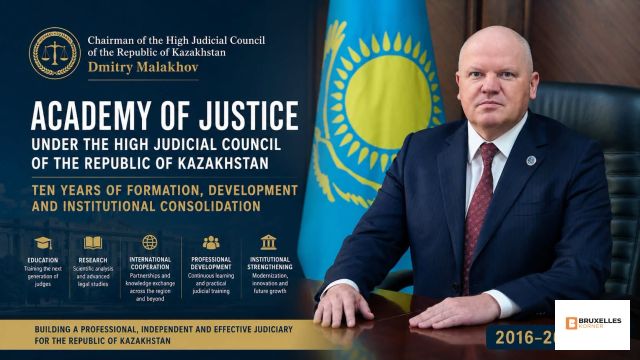





Chairman of the High Judicial Council of the Republic of Kazakhstan
Dmitry Malakhov

Academy of Justice under the High Judicial Council of the Republic of Kazakhstan: Ten Years of Formation, Development and Institutional Consolidation
In 2026, the Academy of Justice under the High Judicial Council of the Republic of Kazakhstan marks the tenth anniversary of its operation. Over this relatively short historical period, the Academy has evolved from a specialised educational establishment into a key institution for developing the personnel capacity of the country’s judicial system, becoming an important element of the judicial and legal reforms under way in Kazakhstan. The anniversary of the Academy has coincided with a new stage in its development, associated with its transfer to the authority of the High Judicial Council, the implementation of large-scale institutional transformations, and the expansion of its educational, research and international activities.
The establishment of the Academy of Justice was a natural stage in the development of the judicial system of independent Kazakhstan. Throughout the years of sovereignty, the country has steadily built a modern model of justice founded on the principles of the rule of law, judicial independence and the professionalism of the judiciary. Against this background, particular importance attached to the task of training a new generation of judges capable of working effectively amid constantly evolving legislation and society’s growing expectations of the quality of justice. It was precisely to address this task that the Academy of Justice was established; today, it is the only specialised higher education institution in Kazakhstan with special status that trains the personnel reserve for the judicial system.
The particular importance of the work of the Academy has been repeatedly emphasised by the country’s leadership. Speaking at the Ninth Congress of Judges in 2024, the President of the Republic of Kazakhstan, Kassym-Jomart Tokayev, highlighted the need to pay particular attention to the rigorous selection of judicial candidates and to the continuous professional development of the judiciary. These priorities largely define the strategic mission of the Academy and its place within the system of judicial authorities.
Over ten years of operation, the Academy has made a significant contribution to building the country’s professional judiciary. Between 2017 and 2025, a total of 638 students completed their studies at the Academy. Of these, 476 have been appointed as judges, and a further 11 have been recommended for appointment to judicial office. Thus, around 80 per cent of graduates have already realised their professional potential directly within the judicial system. The high quality of the training provided is borne out by the results of the qualification examination: in 2025, it was passed successfully by 96 per cent of the graduates of the Academy. It should be noted that comparable results have been maintained over the past four years – one of the most compelling testaments to the effectiveness of the educational model of the Academy.
A landmark event in the institution’s history was its transfer to the High Judicial Council of the Republic of Kazakhstan with effect from 15 July 2024. This step was taken as part of the broader policy of further improving the judicial system and strengthening personnel policy in the justice sector. The change in the institutional subordination of the Academy has made it possible to forge a closer link between the educational process and the practical needs of the judicial system. At the same time, the analysis carried out revealed the need to address a number of tasks relating to the modernisation of educational programmes, the development of research capacity, the launch of doctoral programmes, the improvement of the system of judicial professional development, the strengthening of international cooperation and the modernisation of infrastructure.
The response to these challenges came with the adoption, on 11 February 2025, of the Development Concept of the Academy of Justice for 2025-2027. The document set out six strategic directions of development: improving postgraduate education programmes, developing the system of continuing education, intensifying research activity, introducing new approaches to personnel policy, modernising the physical and technical infrastructure, and strengthening the positive image of the Academy. In essence, the Concept has become a road map for transforming the Academy into a modern research and education centre that meets the best international standards in judicial training.
One of the most important areas of modernisation has been the improvement of the postgraduate education system. In 2025, new curricula were approved for the profession-oriented and the research-and-pedagogical Master’s programmes, developed in the light of the demands of judicial practice and current trends in the development of law. For the first time in the history of the Academy, students were admitted to the research-and-pedagogical Master’s programme, which is designed to build the institution’s own reserve of academic teaching staff. The Master’s programmes of the Academy are attended by employees of the judicial system, the prosecution service and state bodies, as well as by advocates, notaries, private enforcement agents and other representatives of the legal community. The average age of the Master’s students is 35, and their average length of legal service is 11 years, which attests to the high level of professional maturity of the student body.
Of particular significance for the further development of the Academy was the granting, on 4 June 2025, of a state licence to deliver doctoral degree programmes in the field of Law. For the first time in its history, the Academy gained the capacity to train doctoral candidates and to conduct fundamental research into pressing issues in the development of justice. The first doctoral admissions took place as early as October, and the first doctoral students commenced their studies in November.
A distinctive feature of the educational model of the Academy remains the principle of ‘judges teaching judges’. Serving judges, legal scholars and practising lawyers all take part in the educational process. This approach makes it possible to combine fundamental theoretical training seamlessly with the study of real judicial practice. Teaching makes extensive use of modern interactive methods, including the analysis of court cases, simulated trials, role-playing exercises, discussions and team-taught classes. An essential role is played by practical placements in the courts of the city of Astana, where students have the opportunity to study the real mechanisms of the administration of justice and the specific nature of judicial work.
Guest lectures by members of the High Judicial Council have become a new element in the training of future judges. For the first time in the history of the Academy, this format was incorporated into the educational process as a dedicated instrument for the professional development of Master’s students. At these meetings, members of the Council share their practical experience and speak about the current requirements of the judicial profession, the specifics of the competitive selection process, the most common mistakes made by candidates, and the professional qualities needed for success as a judge. Such lectures have enabled a direct dialogue between future judges and representatives of the body responsible for the formation of the country’s judiciary.
Significant changes have also taken place in the field of continuing education. In 2025, the Academy began, for the first time, a phased transition from traditional standardised professional development programmes to individualised learning pathways. The new approach involves designing training programmes around judges’ specific professional needs and identified gaps in knowledge. This mechanism makes it possible to enhance considerably both the effectiveness of training and its practical orientation.
During the period under review, specialised courses were organised on judicial proceedings involving jurors, as well as on the protection of honour, dignity and business reputation in civil proceedings.
For the first time, some of the face-to-face professional development courses were held directly on the premises of the High Judicial Council. This format strengthened the link between the continuing education system and the work of the body responsible for the personnel development of the judicial system, and broadened the opportunities for professional interaction between course participants and members of the Council.
In addition, the institution of the referendariat – an intensive preparation programme for candidates for judicial office – was introduced for the first time. To date, four training cohorts have been held in civil, criminal and administrative law, attended by 90 participants, including advocates, prosecutors, notaries, law-enforcement officers and members of other legal professions.
Another significant initiative was a large-scale intensive legal training course for judicial candidates, organised in December 2025 at the initiative of the High Judicial Council jointly with the Supreme Court, the Academy of Justice, the Judicial Administration and the OSCE Programme Office in Astana. The aim of the training was to raise the quality of preparation of judicial candidates, to develop practical skills in legal analysis, argumentation and the drafting of judicial acts, and to provide comprehensive preparation for all stages of the qualification examination. More than one hundred candidates from various regions of the country took part. At the premises of the Academy, participants undertook mock tests on knowledge of legislation, practical classes and specialised training sessions in preparation for the qualification examination. The implementation of this project was an important step in improving the mechanisms for forming the personnel reserve of the judicial system.
The strengthening of its research capacity has lent substantial impetus to the development of the Academy. On 10 April 2025, the Science Committee of the Ministry of Science and Higher Education accredited the Academy, for the first time, as a research entity. This decision opened up opportunities to participate in national and international grant programmes, to carry out research projects and to expand expert and analytical work. As early as 2025, members of the teaching staff of the Academy took part in competitions for grant funding of scientific research.
An important milestone was the inclusion, on 14 July 2025, of the academic journal Bulletin of the Academy of Justice in the list of recommended scholarly publications. The journal has been modernised in line with international requirements and migrated to the Open Journal Systems platform, and all published articles are now assigned international Digital Object Identifiers (DOIs). This has substantially raised the standing of the journal and broadened the scope for integrating domestic research into the global research community.
The international activities of the Academy merit particular attention. In 2025, the geographical scope of cooperation with foreign educational and research institutions was considerably expanded. Memoranda of cooperation were signed with 12 organisations from Kazakhstan, Germany, Russia, Azerbaijan, Kyrgyzstan and Uzbekistan. Of particular importance is the developing partnership with the Academy of Justice of the Republic of Uzbekistan, aimed at sharing experience in judicial training and implementing joint educational initiatives.
Overseas placements and academic mobility programmes have become an important instrument of international integration. Master’s students of the Academy have completed placements in Germany, the Russian Federation and Azerbaijan. The practice of inviting foreign experts to lecture on judicial work, the protection of human rights and current trends in the development of justice has continued.
The largest international event of 2025 was the International Forum of the Turkic Judicial Training Network, on the theme ‘Protection of Human Rights and Effective Justice: Balancing National Traditions and International Standards’, held in December 2025 and timed to coincide with the tenth anniversary of the High Judicial Council. The Forum brought together representatives of educational institutions from Kazakhstan, Türkiye, Azerbaijan, Kyrgyzstan and Uzbekistan engaged in training personnel for the judicial and law-enforcement systems.
On 28 April 2026, an international research-and-practice conference was held to mark the tenth anniversary of the Academy of Justice under the High Judicial Council of the Republic of Kazakhstan, on the theme ‘Continuous Judicial Education in the 21st Century: Integration of Theory and Practice as the Basis for Improving the Quality of Justice’. Alongside the heads of state bodies, members of the judiciary and Kazakhstani scholars, the conference was attended by foreign experts from Azerbaijan, the United Kingdom, Germany, Kyrgyzstan, Poland, Uzbekistan, Russia and Türkiye. The conference provided a significant platform for discussing contemporary approaches to the training and professional development of judges.
An important component of the modernisation of the Academy has been the improvement of its facilities and technical resources. For the first time, a forensic training facility has been established for conducting practical classes and research using modern forensic equipment. An information system has been introduced that automates the educational process and increases the transparency of learning management. Work continues on modernising and automating the library collection, upgrading computer equipment and developing the digital infrastructure. Looking further ahead, consideration is being given to a project to construct a new campus for the Academy.
Serious attention is being paid to building a positive public image of the institution. Throughout 2025, the Academy considerably stepped up its information and outreach activities. Articles and interviews were published, television and radio programmes were organised and live broadcasts featuring members of the teaching staff and students were held. For the first time, the results of the work of the Academy were presented at the Central Communications Service under the President of the Republic of Kazakhstan – an important step in strengthening openness and public trust.
Another significant event was the state attestation of the Academy, conducted for the first time by the High Judicial Council. Following a comprehensive review, the educational activities of the Academy were found to be fully compliant with the state compulsory standards of higher and postgraduate education. Work is currently continuing on the implementation of the commission’s recommendations aimed at the further development of research and educational activity.
In summing up the first decade, it can be stated with confidence that the Academy of Justice under the High Judicial Council has become a key institution in strengthening the country’s judicial system. At the same time, it was the transfer of the Academy to the authority of the High Judicial Council in 2024 that marked the starting point of a new stage in its development. Thanks to the Council’s systematic support, the introduction of modern approaches to governance and the consistent implementation of personnel policy, it proved possible within a short period to launch large-scale transformations in education, research, international cooperation and infrastructure development. The very first results of the implementation of the Development Concept for 2025-2027 attest to the strong momentum of institutional change and the effectiveness of the chosen course.
At present, the Academy performs not only educational and research functions but also serves as a centre for professional dialogue and international cooperation in the field of judicial education.
Today, the Academy of Justice is moving beyond the bounds of a national educational institution. It is gradually becoming an important regional platform for professional engagement among the states of Central Asia and the Turkic world on matters of judicial training and the improvement of judicial education. International cooperation, research, modern educational technologies and practice-oriented training are laying the foundations for the formation of a new generation of judges capable of responding effectively to the challenges of the times and upholding the rule of law.
Over the past eighteen months, the Academy has gained fresh impetus for growth, substantially expanded its areas of activity and consolidated its position as the national centre of judicial education.
The next stage of its development involves the pursuit of still more ambitious objectives: the development of research schools, the introduction of digital technologies, further integration into the international educational space and the creation of a modern infrastructure for judicial education. Yet it is already evident today that the Academy of Justice under the High Judicial Council occupies a special place in the country’s justice system and makes a significant contribution to building a professional, independent and effective judiciary for the Republic of Kazakhstan.
Yorum Yazın