
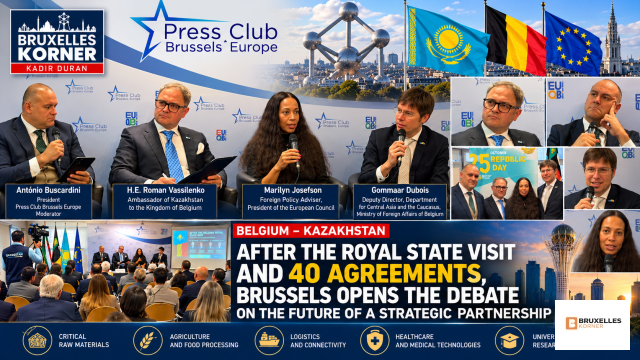





Belgium–Kazakhstan: After the Royal State Visit and 40 Agreements, Brussels Opens the Debate on the Future of a Strategic Partnership
At the Press Club Brussels Europe, Kazakhstan's Ambassador Roman Vassilenko brought together diplomats, institutional representatives, experts, journalists and business leaders to assess the outcomes of King Philippe and Queen Mathilde's State Visit to Kazakhstan. From critical raw materials and international transport corridors to university cooperation and societal challenges, one central question dominated the discussions: how can the 40 agreements announced during the royal visit be translated into tangible achievements?
By Kadir Duran — Bruxelles Korner
Brussels, 23 October 2026 — Report and analysis based on the Ambassador's address and discussions recorded during the panel.

A Diplomatic Gathering to Prepare for the Post-Royal Visit Era
On Friday, 23 October, the Press Club Brussels Europe, located at 95 Rue Froissart, hosted a discussion on the future of Belgian–Kazakh relations, organised at the initiative of the Embassy of Kazakhstan in Belgium.
Entitled “After the Belgian Royal State Visit: What's Next for Belgium–Kazakhstan Relations?”, the panel followed the historic State Visit of King Philippe and Queen Mathilde to Kazakhstan from 12 to 14 October 2026.
Nearly one hundred participants from different professional backgrounds attended the presentations and took part in the discussions. Diplomats, business representatives, researchers, international relations specialists and journalists had the opportunity to raise questions and exchange views with the speakers.

Four Key Figures at the Centre of the Discussion
H.E. Roman Vassilenko, Ambassador of Kazakhstan to the Kingdom of Belgium and the Grand Duchy of Luxembourg, and Permanent Representative to the European Union.
Gommaar Dubois, Deputy Director of the Department for Central Asia and the Caucasus at the Belgian Ministry of Foreign Affairs.
Marilyn Josefson, Foreign Policy Adviser to the President of the European Council.
António Buscardini, President of the Press Club Brussels Europe, who moderated the discussion.
Beyond the diplomatic protocol, the purpose of the meeting was to sustain the momentum generated by the royal visit and encourage direct dialogue on the next stages of bilateral cooperation.
A State Visit, however significant, is not an end in itself. It initiates a process whose results must eventually translate into investment, industrial partnerships, university programmes and practical cooperation projects.
Roman Vassilenko: “The Real Work Begins When the Signing Pens Are Put Away”
In his opening address, Ambassador Roman Vassilenko highlighted the historic significance of the royal visit.
It was the first State Visit by a Belgian monarch to Kazakhstan and, indeed, the first such visit to Central Asia.

Organised at the invitation of President Kassym-Jomart Tokayev, the visit established a renewed framework for political and economic cooperation between the two countries.
The two Heads of State adopted a Joint Statement, while their Foreign Ministries signed a Road Map covering the period 2027–2029.
The Ambassador placed particular emphasis on moving beyond declarations towards concrete achievements.
His central message was clear: signatures mark the beginning of cooperation, but their real value depends on implementation.
This distinction is fundamental. In contemporary economic diplomacy, the number of agreements announced may demonstrate political and institutional mobilisation, but it does not guarantee implementation, financing or economic returns.

Forty Cooperation Documents: A New Phase of Work Begins
The Ambassador presented the following figures:
40 cooperation documents announced during the royal visit.
16 commercial agreements covering strategic economic sectors.
22 academic and research agreements involving universities and scientific institutions.
A Joint Statement and a 2027–2029 Road Map providing the political and institutional framework.
These agreements cover agriculture, logistics, industry, healthcare, advanced technologies, higher education and scientific research.
In a previous Bruxelles Korner article, I had already provided an initial overview of the forty documents and the sectors concerned.
Previous article: Belgium–Kazakhstan: 40 Agreements in Four Days — Kadir Duran, Bruxelles Korner, 21 October 2026.
The latest meeting offered an opportunity to go further. The question is no longer simply what was signed, but how Belgian and Kazakh partners intend to implement their commitments.
Further meetings, sector-specific discussions and technical exchanges will be necessary to advance these projects. Their precise timetable has yet to be established.
Five Priority Sectors for Belgian–Kazakh Cooperation

1. Critical Raw Materials: Moving Beyond Extraction
Kazakhstan possesses significant mineral resources, while Belgium has industrial expertise in metallurgy, advanced materials processing and recycling.
The stated ambition is to develop value chains combining extraction, processing, research, technology and training.
This approach is consistent with European efforts to diversify strategic supply chains.
2. Agriculture: Developing Local Processing Capacity
Belgian companies Vandeputte, Scaldis and Linagro were mentioned among the partners involved in projects relating particularly to the supply of Kazakh linseed to European markets.
Other opportunities include wheat processing, vegetable oils and agricultural technologies.
The objective extends beyond exports. It also involves developing industrial processing capacity and generating added value within Kazakhstan.
3. Logistics: Connecting Antwerp-Bruges to the Caspian Sea
The Middle Corridor, also known as the Trans-Caspian International Transport Route, occupies an increasingly important place in connectivity strategies between Europe and Central Asia.
Potential cooperation between the Port of Antwerp-Bruges and Kazakhstan's Caspian ports of Aktau and Kuryk could contribute to the diversification of international trade routes.
The Ambassador also referred to five weekly cargo flights between Liège and Karaganda, presented as an example of already operational connectivity.
4. Healthcare: Oncology and Medical Technologies
Medical cooperation represents another area of development, particularly in oncology, clinical research and specialist training.
Belgian company IBA, which has been involved in cooperation with Kazakhstan for more than a decade, illustrates the opportunities offered by advanced medical technologies.
5. Universities and Artificial Intelligence: Investing in Future Generations
The 22 academic and scientific agreements create opportunities for student exchanges, researcher mobility, joint doctoral programmes and collaborative research.
The areas discussed include engineering, artificial intelligence and critical raw materials.
The royal couple's visit to the Alem.ai centre also highlighted Kazakhstan's digital ambitions.
For both countries, university cooperation can become an instrument of lasting engagement, extending beyond political and economic cycles.

Questions from the Audience: New Perspectives Beyond Commercial Agreements
The second part of the meeting addressed broader issues, including academic cooperation, partnerships between local authorities, the future of young people, environmental challenges and the capacity of both societies to anticipate the transformations of the coming decades.
The following exchanges are reconstructed from notes and a partial transcript recorded during the session. Responses have been paraphrased rather than presented as verbatim quotations.
Critical Raw Materials: The European Union Wants to Develop Local Value Chains
One question focused on practical cooperation projects involving critical raw materials and Kazakhstan's potential role in emerging European supply chains.
Marilyn Josefson emphasised that this sector is an important priority in relations between the European Union and Kazakhstan.
However, she acknowledged that she did not have detailed information about the specific projects currently under consideration in Astana.
She nevertheless outlined an essential principle of the European approach: cooperation should not be limited to extracting resources in partner countries and subsequently processing them in Europe.
The objective is also to develop local processing capacity, technological expertise and industrial activities within partner countries.
Recycling and environmental sustainability must be integral components of this approach.
This response highlights an important development in European resource diplomacy: securing strategic supplies must be balanced with the industrial ambitions of resource-producing countries.

A European Union–Kazakhstan or EU–Central Asia Research Institute in Astana?
Another participant proposed establishing a research institute dedicated to relations between the European Union and Kazakhstan, or potentially between the EU and Central Asia as a whole.
Such an institution could bring together researchers, students, European affairs specialists and institutional representatives through training programmes, conferences and scientific research.
Ambassador Roman Vassilenko expressed openness to considering the proposal.
He explained that its implementation would require identifying suitable academic and institutional partners.
In his view, the time has come to deepen research into how the European Union operates and how political and scientific cooperation could be strengthened.
At this stage, however, the idea remains a proposal raised during the discussion, rather than an officially announced institutional project.
City Diplomacy: Towards New Twinning Partnerships?
Cooperation between local authorities was another topic raised during the discussion.
The Ambassador recalled existing ties between Semey, a Kazakh city marked by the history of Soviet nuclear testing, and Ypres, a Belgian city associated with the memory of chemical weapons used during the First World War.
This relationship illustrates how historical memory can provide a foundation for international cooperation.
Roman Vassilenko also indicated that further initiatives involving Belgian and Kazakh cities were under consideration, expressing hope that progress could be achieved in the coming months.
Partnerships between municipalities could open opportunities in culture, education, heritage and tourism.

Honorary Consulates: A More Decentralised Diplomatic Presence
During the exchanges, Gommaar Dubois addressed the expansion of the honorary consular network.
He referred to the opening of a third honorary consulate, describing the development as exceptional within Belgium's established diplomatic practices.
The objective is to support growing economic and people-to-people relations beyond the two capitals.
This dimension is particularly relevant in a federal country such as Belgium, where the Regions play a direct role in foreign trade and international economic partnerships.
Looking Ahead to 2040: Water, Youth, Social Cohesion and the Environment
One of the most forward-looking interventions encouraged participants to look beyond immediate economic priorities and consider the challenges of 2040.
The question concerned the risks of cascading crises: water scarcity, agricultural vulnerabilities, social tensions, demographic ageing, difficulties facing young people and environmental degradation.
The participant suggested that future international cooperation could also focus on ecosystem restoration, repairing environmental damage and strengthening the social fabric.
The central idea was that future generations of economic activity might emerge not only from resource extraction but also from the capacity to restore living conditions and social and environmental stability.
Roman Vassilenko's Response: Building Responsible Citizenship
The Ambassador responded by outlining several national initiatives promoted by President Kassym-Jomart Tokayev.
He referred to the concept of Adal Azamat, associated with the idea of an honest and responsible citizen.
He also highlighted programmes encouraging volunteerism, reading and civic participation.
Among the initiatives mentioned was Taza Kazakhstan, a national programme promoting cleanliness, environmental protection and tree planting.
The Ambassador referred to the country's ambition to plant two billion trees.
According to him, these initiatives are intended to strengthen youth engagement and social cohesion in Kazakhstan's diverse society.
The effectiveness of these government objectives will ultimately need to be assessed through measurable outcomes, particularly in civic participation, environmental protection and improvements in living standards.

Kazakhstan and the European Union: A Relationship Extending Far Beyond Bilateral Cooperation
In his address, Roman Vassilenko also placed the royal visit within the broader framework of relations between Kazakhstan and the European Union.
According to the figures he presented, trade between Kazakhstan and the European Union exceeded US$45 billion in 2025, with the EU accounting for approximately 40% of Kazakhstan's foreign trade.
He recalled that the Enhanced Partnership and Cooperation Agreement, which fully entered into force in 2020, covers 29 areas of cooperation.
Three major priorities emerge from this partnership: Eurasian connectivity; energy security and critical raw materials; and research, innovation and people-to-people exchanges.
The Ambassador also discussed prospects for visa facilitation, investment in Trans-Caspian infrastructure and Kazakhstan's ambition to strengthen its links with European research programmes, including Horizon Europe.
The regional dimension remains essential.
The EU–Central Asia Summit held in Samarkand in April 2025 strengthened the political framework for relations between the two regions.
For Brussels, Kazakhstan therefore represents both a bilateral partner and an important participant in the wider development of EU–Central Asia cooperation.

Bruxelles Korner Analysis: The Real Test Begins After the Diplomacy of Signatures
The meeting on 23 October highlighted one fundamental question:
How can shared political ambitions be transformed into measurable economic and institutional results?
The forty announced instruments provide a framework for cooperation, but they represent different levels of commitment.
A university memorandum, a political declaration and a commercial contract do not produce the same legal or economic effects.
Belgian communications refer to 17 agreements between companies and 22 academic agreements, while the Ambassador's prepared speech mentions 16 commercial agreements.
This difference in classification deserves documentary clarification, without necessarily calling into question the overall total of forty instruments announced by the authorities.
To evaluate the results of the State Visit over the coming years, several indicators will need to be monitored: investments actually committed, operational industrial projects, funded research programmes, genuine academic mobility and new connectivity infrastructure.
Another important issue concerns institutional continuity.
Industrial, scientific and logistics projects frequently require several years of preparation.
Their progress will depend on the ability of administrations, businesses, universities and financial institutions to maintain regular dialogue.
The 2027–2029 Road Map therefore represents an important coordination instrument.
It will also be necessary to examine how European economic security interests can be reconciled with Kazakhstan's ambition to develop its own processing industries.
This relationship cannot be understood merely as an exchange between a supplier of natural resources and a consumer market.
It forms part of a wider restructuring of international value chains, trade routes and technological partnerships.

Further Meetings Will Be Necessary
The session concluded with an invitation from António Buscardini to continue the discussions informally during a networking reception.
Several questions remained unanswered because of time constraints, illustrating the breadth of issues raised by this new phase of Belgian–Kazakh relations.
Future meetings could provide opportunities to examine sector-specific projects in greater depth, connect economic stakeholders and clarify the practical arrangements required to implement the agreements.
For Bruxelles Korner, monitoring these developments will remain an important part of its coverage of relations between Belgium, Kazakhstan and the European Union.
The next stage will not simply be about announcing additional partnerships, but about documenting those that become operational.
Conclusion — From the Royal State Visit to Long-Term Cooperation
On 23 October 2026, at the Press Club Brussels Europe, Belgium and Kazakhstan continued the dialogue initiated during the historic State Visit of King Philippe and Queen Mathilde.
The discussions demonstrated that the opportunities extend beyond critical raw materials, logistics and industrial contracts.
They also concern youth education, scientific research, environmental protection and closer relations between the two societies.
Just two days before Kazakhstan's Republic Day on 25 October, and ahead of the country's 35th anniversary of independence in December, Roman Vassilenko presented this cooperation as part of Kazakhstan's wider economic and institutional modernisation.

The royal visit provided political momentum. The forty agreements established a framework for cooperation. The challenge for the coming years will be to transform these commitments into sustainable projects that deliver tangible benefits for both countries.
For Belgium, the challenge also involves consolidating its presence in a region that is becoming increasingly relevant to trade between Europe and Asia.
For Kazakhstan, the objective is to diversify international partnerships, develop industrial capabilities and strengthen integration into European research and innovation networks.
The story of this new chapter in Belgian–Kazakh relations has yet to be written.
Further Reading — Bruxelles Korner
Belgium–Kazakhstan: 40 Agreements in Four Days
Kadir Duran — Bruxelles Korner, 21 October 2026.
Sources and References
Press Club Brussels Europe — Official programme, 23 October 2026.
Embassy of Kazakhstan in Belgium — Report on the Brussels meeting.
Belgian Federal Public Service Foreign Affairs — Belgium–Kazakhstan relations.
Presidency of Kazakhstan — Joint Statement of 12 October 2026.
Prepared address by H.E. Roman Vassilenko and notes from interventions recorded during the panel on 23 October 2026, provided to Bruxelles Korner.
© Bruxelles Korner — Kadir Duran | Diplomacy, Geopolitics and International Relations.
Yorum Yazın