
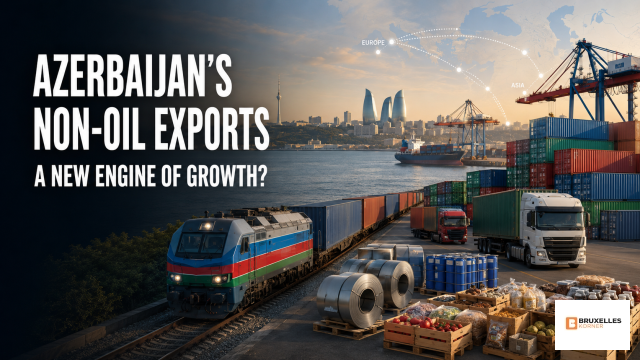





Azerbaijan Subsidises Transport Costs: Can Non-Oil Exports Become a New Engine of Growth?
Abdulhamid Hamid Al-Kba
Opinion writer specialising in Central Asia and Azerbaijani affairs

Less than three weeks remain before 1 September 2026, when President Ilham Aliyev’s decree supporting transport costs for non-oil exporters, signed on 9 June, enters into force. As implementation approaches, one central question arises: can assistance covering up to 70% of transport costs make Azerbaijani non-oil products significantly more competitive in international markets?
The answer is closely linked to Azerbaijan’s broader efforts to diversify its economy and reduce its dependence on oil and gas revenues. Non-oil exports nearly doubled between 2020 and 2025, rising from approximately $1.9 billion to $3.6 billion. Yet logistics costs remain one of the main barriers to further expansion, particularly in more distant markets.
The new decree seeks to address that obstacle through a direct and practical mechanism at a time when Baku is trying to strengthen the international competitiveness of domestically produced goods.
How the support mechanism works
Under the decree, the amount of support will be determined according to two criteria: the transport expenses paid through non-cash transactions and the customs value of the exported goods.
When goods are transported by rail, air or sea—or by road vehicles registered in Azerbaijan—70% of the transport costs will be taken into account. When foreign-registered road vehicles are used, the applicable rate falls to 50%.
The scheme also imposes a ceiling based on the customs value of the goods: 15% for road, rail and air transport, and 5% for maritime transport. Exporters will receive whichever of the two calculated amounts is lower.
The mechanism also covers domestic transport from Nakhchivan to other parts of Azerbaijan, reimbursing 70% of eligible expenses. This provision is particularly significant given the exclave’s geographical position and the logistical constraints faced by its producers.
The support programme will run from 1 September 2026 until 30 September 2036.
More than a symbolic measure
These rates are economically significant. For an exporter sending agricultural or food products to European or Asian markets, transport can account for a substantial share of the final price—especially when profit margins are already narrow.
Covering between 50% and 70% of eligible transport expenses could reduce that burden considerably. Exporters may then be able to offer lower prices, retain higher margins or pursue a combination of both. In principle, this should improve price competitiveness and help Azerbaijani producers enter more distant and diversified markets.
Agricultural and food products, chemicals, aluminium and electricity have all contributed to the growth of non-oil exports over the past five years. Further expansion, however, will depend partly on whether Azerbaijani products can reach international customers at competitive logistical costs.
A measured approach—with potential risks
From an economic-policy perspective, the decree appears relatively balanced. The higher support rate for Azerbaijani-registered transport encourages the use of the domestic transport fleet and may stimulate investment in logistics capacity.
At the same time, ceilings linked to customs value should help limit abuse and discourage the artificial inflation of transport expenses. The programme’s ten-year duration also provides exporters with an unusually stable planning horizon, unlike short-term or temporary subsidy schemes.
Moreover, eligibility is restricted to products of Azerbaijani origin and to non-oil and non-gas exports. The measure is therefore clearly aligned with the government’s strategic objective of economic diversification.
Nevertheless, the difference between the 70% rate for Azerbaijani-registered vehicles and the 50% rate for foreign vehicles raises a legitimate concern: does the domestic transport fleet currently have enough capacity to absorb the anticipated increase in demand?
If the supply of trucks and logistics services proves insufficient, the programme could unintentionally drive up domestic transport prices, offsetting part of the intended benefit. Its financial sustainability over a ten-year period will also depend on the capacity of the state budget—or other funding mechanisms—to maintain the scheme if energy revenues come under renewed pressure.
The first meaningful results may emerge in 2027
The programme’s real impact is likely to become visible gradually, beginning in 2027, once exporters have adapted to the administrative procedures and started submitting applications through the Ministry of Economy.
Agricultural and food producers are expected to be among the main beneficiaries because their goods are particularly sensitive to transport costs. Their success, however, will depend on prompt reimbursement and on whether export support corresponds to actual demand in destination markets.
Producers in Nakhchivan could also benefit considerably from assistance with domestic transport, allowing the region to become more closely integrated into the national economy.
At the regional level, the measure may indirectly reinforce Azerbaijan’s logistical position along the Middle Corridor, particularly as transport links continue to develop with Georgia, Türkiye and Iran.
Subsidies alone cannot guarantee competitiveness
Government assistance is not a magic solution. Sustainable export competitiveness also depends on product quality, compliance with international standards, production efficiency, access to finance, branding and effective marketing.
There is also a risk that exporters could become excessively dependent on public support if the programme is not accompanied by structural improvements to the business environment.
Its success will therefore require transparent implementation, clearly defined lists of eligible goods and destination countries, straightforward application procedures and the prompt disbursement of payments.
In my view, the decree represents a logical and measured step in Azerbaijan’s economic-diversification strategy. It addresses a genuine obstacle through a direct policy instrument while introducing safeguards intended to limit market distortions.
Its long-term value, however, will depend on whether transport support is accompanied by improvements in infrastructure, customs procedures, quality standards, access to finance and international marketing. Without these complementary measures, its impact may remain limited.
Economic diversification remains a strategic necessity for Azerbaijan at a time of geopolitical uncertainty and volatile energy prices. The new transport-support programme is an important milestone on that road, but its ultimate success will be determined by the quality of its implementation—and by the private sector’s capacity to turn lower logistics costs into sustainable export growth.
Yorum Yazın