





Arab Academy Launches International Educational Initiative in Digital Game Development
Amr Yehia
The importance of investing in young minds, discovering their potential, and turning their ideas into executable innovations stands out in a world where technology has become an open space for creativity and building the future. In this context, the Arab Academy for Science, Technology and Maritime Transport launched an international educational initiative in the field of digital game development, by organizing the event "UEFN G4C International Student Challenge Game Jam," in cooperation with the Ministry of Education and Technical Education, with the aim of developing students' digital and creative skills and giving them the opportunity to learn about the latest technologies in interactive game industry.

The initiative combines knowledge and practical application, and gives students the opportunity to move from being merely users of technology to becoming creators and developers capable of producing digital content that reflects their ideas and identity, and contributes to shaping the features of the future.
The initiative comes within the framework of Dr. Ismail Abdel Ghaffar Ismail Farag, President of the Arab Academy for Science, Technology and Maritime Transport's, keenness to support innovation and keep pace with global technological developments, and to enhance integration between educational institutions, in a way that contributes to preparing a generation capable of keeping up with future requirements.
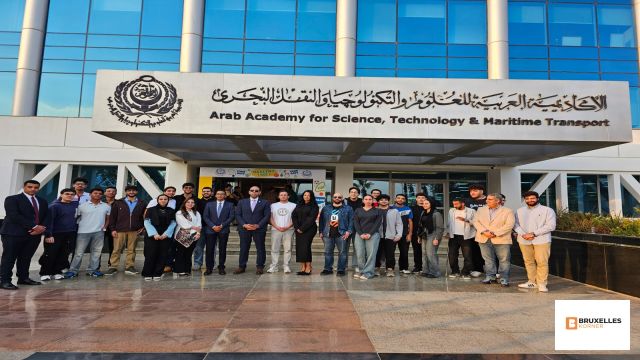
The event was held over three days, from October 29 to 31, 2026, at the headquarters of the Arab Academy for Science, Technology and Maritime Transport at the Smart Village Branch, with the participation of 50 students, 25 students from the College of Computing and Information Technology at the Academy, and 25 students from the Nile Schools affiliated to the Ministry of Education.
The event was organized under the leadership of Engineer Ahmed Sharaf, Communications Officer at the Office of the President of the Academy for Information and Communications Technology, and in cooperation with the game development team using UEFN technology, where the program included practical and interactive training on the use of Unreal Editor for Fortnite tools and techniques, allowing students to explore the areas of digital game design and development, and to turn their creative ideas into projects and interactive experiences.
The program witnessed practical applications focused on developing creative thinking, problem-solving and teamwork skills, and linking academic knowledge with practical application, in addition to providing students with the opportunity to interact with experts and specialists in the field of digital game industry, within an international challenge that combines learning, competition and innovation.

For his part, Engineer Ahmed Sharaf, Communications Officer at the Office of the President of the Arab Academy for Science, Technology and Maritime Transport, announced the launch of a pioneering educational experience in the field of electronic game design and programming, in cooperation with the Ministry of Education and Technical Education, aimed at discovering students' talents and developing their technological and creative skills, and preparing a generation capable of keeping pace with rapid developments in the digital labor market.
He added that the initiative was launched in cooperation with the Ministry of Education, where the Academy implemented the program, with the College of Computing and Information Technology at the Smart Village headquarters supervising the technical and training aspect, led by Dr. Aliaa Youssef, Dean of the College of Computing and Information Technology at the Academy, praising her efforts and the work team in supporting students and helping them pass through stages of the experience.
He pointed out that the initiative witnessed a turnout from students that exceeded the target numbers, reflecting the youth's interest in technology and the fields of programming and game design, noting that the winners are scheduled to be announced during the period from November 7 to 11, coinciding with the "Cairo ICT" exhibition.
Sharaf stressed that the success of the experience represents a nucleus for its repetition and expansion in the coming period, with the possibility of launching similar initiatives in other fields, such as content creation and media production, in addition to programming and artificial intelligence, stressing that these fields are no longer just future specializations, but have become a reality that imposes the need to prepare students to deal with it.
Regarding the controls of the participating games, he explained that the Academy was keen that the games presented be suitable for the targeted age groups, and not include scenes of violence, blood or inappropriate insinuations, to ensure the provision of safe entertainment and educational content, and enhance the creative and developmental aspect of students.
For his part, Dr. Khaled Shafei, Dean of the Arab Center for Artificial Intelligence, stressed the importance of the initiative launched by the Arab Academy for Science, Technology and Maritime Transport in cooperation with the Ministry of Education to train students on designing and programming electronic games, noting that it represents an important step towards employing youth energies in the field of technology and digital content industry.
"Shafei" explained that the initiative gains special importance in light of the widespread spread of electronic games among children and youth, and the content of some circulating games that may not be compatible with the cultural and social values of Arab societies, stressing the need to move from the stage of consuming games to participating in designing and producing them.
He added that teaching students the basics of programming and using simple technological tools gradually allows them to develop their own games, and gives them an opportunity to enter a promising market with great economic potential, noting that this experience can represent the beginning of establishing start-up companies specialized in designing and producing electronic games.
He pointed out that developing games that carry Egyptian and Arab identity and culture, and reflect societal customs and traditions, would open new markets for young people, not only in Egypt, but also in various Arab countries, in addition to reducing dependence on global games and the associated spending in foreign currencies.

He revealed the Arab Center for Artificial Intelligence's intention to participate in implementing the initiative in cooperation with the Academy and its partners, and to expand its organization in the coming period through advanced training levels, after the first level focused on introducing students to the basics of game design and programming.
He added that the next steps aim to introduce artificial intelligence technologies into the game industry, allowing the development of more interactive experiences that go beyond traditional play to designing games that rely on more advanced player-computer interaction.
He stressed that the initiative represents the beginning of a training path that can be built upon in the future, to prepare Arab cadres capable of competing in the electronic game industry, and to benefit from the investment and entrepreneurship opportunities provided by this sector.
Meanwhile, Dr. Aliaa Youssef, Dean of the College of Computing and Information Technology at the Arab Academy for Science, Technology and Maritime Transport at the Smart Village Branch, confirmed that the event represents an important opportunity for college students and school students to interact directly, exchange experiences, and learn about the areas of digital game development and interactive content industry.
She added that the initiative aims to introduce students to the scientific and technical aspects related to the game industry, explaining that digital games are not limited to being a means of entertainment, but are based on an integrated system of knowledge, design and programming, which allows students to discover their potential in this field, and move from the stage of using games to participating in their development and production.
She pointed out that the turnout for participation exceeded expectations, as about 85 students applied, despite the event coinciding with the beginning of students' exams, which reflects their interest in the experience and their desire to learn about modern technology fields.
She explained that the experience allowed students to participate in designing game characters and components and implementing their ideas in a practical manner, noting that students showed distinct levels of creativity, and that some of the ideas they presented reflected a clear ability to innovate and think outside traditional frameworks.
She pointed out that the initiative also seeks to direct students towards developing games that carry positive content, and reflect Egyptian identity and its civilizational history, noting that some projects dealt with topics inspired by Egypt and the pyramids, and presented ideas that carry purposeful messages.
Dr. Aliaa Youssef expressed her aspiration to repeat the experience in the coming period, and expand the scope of participation to include larger numbers of students, which contributes to enhancing their digital and creative skills, and providing broader opportunities for them to learn about the future of the game industry and interactive technology.
The initiative confirms the importance of employing modern technology in the educational process, and opening new horizons for students to acquire advanced skills in digital content and interactive games industry, which enhances their ability to innovate, and supports their readiness to participate in modern technology fields and the future labor market.
Yorum Yazın