
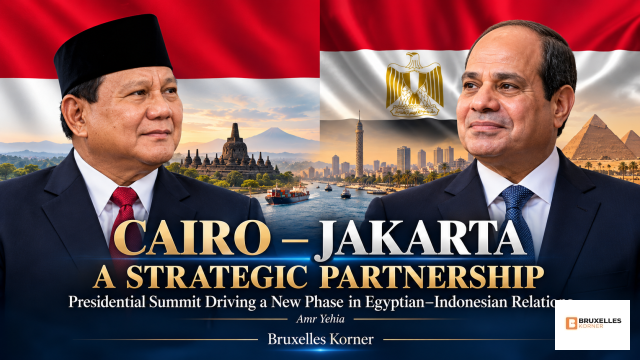





A Strategic Partnership Between Cairo and Jakarta
A Presidential Summit Driving a Pivotal Shift in Egyptian–Indonesian Relations
Egypt and Indonesia seek to transform decades of diplomatic affinity into a strategic partnership spanning maritime security, Palestine, investment, trade and Global South cooperation
By Amr Yehia — Bruxelles Korner

President Abdel Fattah El-Sisi’s Asian tour, launched on 6 October 2026, places Indonesia among the most politically significant stops on an itinerary that also includes South Korea and Malaysia. According to the Egyptian Presidency, the Indonesian leg will form part of a broader effort to deepen Egypt’s political and economic engagement with Asia. Présidence
Jakarta is particularly important because Egyptian–Indonesian relations have already moved beyond conventional bilateral diplomacy. In April 2025, President El-Sisi and Indonesian President Prabowo Subianto signed a joint declaration formally elevating relations between the two countries to the level of a strategic partnership. Both governments identified manufacturing, trade, investment, information and communication technologies, food security and energy among the principal areas in which this partnership should be translated into concrete cooperation. Présidence
The forthcoming presidential talks are therefore expected to focus less on announcing a new political framework than on giving substance to one that already exists.
From historical friendship to strategic coordination
Egypt and Indonesia share a diplomatic relationship rooted in the early years of Indonesian independence. Cairo was one of the first Arab capitals to support the new Indonesian state, creating a political legacy that has endured for decades.
The relationship subsequently developed through multilateral organisations including the United Nations, the Non-Aligned Movement, the D-8 and, more recently, BRICS. Today, that historical affinity is increasingly being translated into geopolitical coordination.
The most recent indication came in September 2026, when El-Sisi and Prabowo met on the sidelines of the 18th BRICS Summit in New Delhi. Their discussions covered the full spectrum of bilateral relations as well as regional crises, maritime navigation and the Palestinian question. Présidence
That meeting effectively prepared the political terrain for the next stage of Egyptian–Indonesian relations.
Two regional powers with growing international weight
The strategic importance of the Cairo–Jakarta relationship is amplified by the demographic, geographic and political weight of the two countries.
Egypt occupies a central position between Africa, the Arab world, the Mediterranean and the Red Sea. Indonesia, meanwhile, is Southeast Asia’s most populous country and one of the principal actors within ASEAN.
Together, they represent two important poles of what is increasingly described as the Global South.
This convergence is becoming especially visible at a time when emerging powers are seeking greater influence over international institutions, trade flows, development financing and the management of geopolitical crises.
For both Cairo and Jakarta, closer coordination offers an opportunity to strengthen their respective positions within a world system that is becoming progressively more multipolar.
Maritime security: from Suez to Southeast Asia
One of the summit’s most strategically important themes is expected to be maritime security.
Egypt’s geopolitical importance is inseparable from the Suez Canal, which remains one of the most important arteries of international commerce. Indonesia, for its part, lies at the heart of Southeast Asian maritime routes, close to the Strait of Malacca and several other passages essential to global shipping.
Instability in the Red Sea, tensions affecting international sea lanes and the vulnerability of supply chains have consequently created a strong area of common interest.
During their September meeting in New Delhi, El-Sisi and Prabowo explicitly stressed the importance of preserving freedom of navigation in international maritime corridors. Présidence
This issue has become increasingly important for Cairo because disruption in the Red Sea directly affects traffic through the Suez Canal and therefore Egypt’s economic interests.
For Jakarta, the same principle is essential because Indonesia’s economic geography is fundamentally maritime.
The two capitals therefore share a strategic concern: ensuring that major trade routes remain open, predictable and protected from the consequences of regional confrontation.
Palestine at the heart of political convergence
The Palestinian question represents perhaps the clearest area of diplomatic convergence between Egypt and Indonesia.
At their September 2026 meeting, the two presidents reaffirmed their support for a two-state solution, the establishment of a Palestinian state on the borders of 4 June 1967 with East Jerusalem as its capital, and their opposition to the displacement of Palestinians from their land. They also called for humanitarian aid to reach Gaza and for the ceasefire arrangements to be implemented. Présidence
Indonesia has traditionally maintained strong diplomatic support for the Palestinian cause, while Egypt remains a central actor because of its geography, its diplomatic channels and its role in humanitarian access through the Rafah area.
This alignment gives Egyptian–Indonesian coordination a significance that extends well beyond bilateral relations.
It also reinforces the political weight of the two countries within the Organisation of Islamic Cooperation and across the wider Muslim world.
Economics: the real test of the strategic partnership
The success of the new partnership will ultimately depend on whether political declarations can be translated into economic results.
The April 2025 strategic partnership declaration specifically identified manufacturing, trade, investment, ICT, food security and energy as priority areas. Présidence
Indonesia already represents an important Asian trading partner for Egypt, with commercial exchanges covering commodities, agricultural products, fertilisers, industrial inputs, textiles, electronics and food products.
But the ambition now is considerably broader.
Egypt is seeking to attract greater Indonesian investment, particularly in industrial and logistics projects. The Suez Canal Economic Zone could play an important role in this strategy by offering Indonesian companies a platform from which to serve African, Arab and European markets.
For Indonesia, Egypt offers more than a domestic market. It represents a geographic gateway linking several economic regions.
For Egypt, Indonesian investment would also contribute to its wider policy of diversifying foreign capital and strengthening partnerships with Asian economies.
The forthcoming presidential discussions will therefore be closely watched by business communities on both sides.
Al-Azhar: Egypt’s most enduring soft-power bridge
Another distinctive feature of Egyptian–Indonesian relations is the role played by education and religious diplomacy.
For generations, Indonesian students have travelled to Egypt to study at Al-Azhar, creating a deep intellectual and cultural relationship between the two societies.
This educational connection has produced networks extending far beyond government institutions.
Indonesian graduates of Egyptian universities have gone on to become scholars, religious leaders, public officials and educators, making Al-Azhar one of Egypt’s most important sources of soft power in Southeast Asia.
This human dimension gives the strategic partnership a level of social depth that many bilateral relationships lack.
Cooperation between Al-Azhar and Indonesian institutions also supports dialogue on religious education, moderation, tolerance and the fight against extremist ideologies.
Tourism and direct connectivity
Tourism represents another sector with considerable potential.
Egypt’s archaeological heritage, Islamic monuments and religious sites attract Indonesian visitors, while Indonesia offers one of Asia’s most dynamic tourism markets.
Improved air connectivity could therefore become an important component of the bilateral agenda.
A direct or significantly strengthened Cairo–Jakarta aviation link would facilitate tourism, investment, educational exchanges and business travel while giving practical expression to the strategic partnership.
Connectivity, in this sense, is not merely logistical.
It is one of the conditions required for political rapprochement to produce durable economic and social effects.
A wider Global South calculation
The Cairo–Jakarta rapprochement should also be understood in the broader transformation of international relations.
Both Egypt and Indonesia are attempting to maintain diversified foreign policies rather than align exclusively with a single geopolitical bloc.
Their participation in BRICS illustrates this search for greater strategic autonomy and stronger representation for emerging economies.
The two states also share an interest in reforming aspects of global governance and increasing the influence of developing countries in international decision-making.
For Cairo, stronger ties with Indonesia reinforce its Asian diplomacy.
For Jakarta, Egypt represents one of the most influential political gateways to the Arab world and Africa.
The relationship is consequently becoming more than bilateral.
It is increasingly part of a network of South–South partnerships linking emerging powers across regions.
Jakarta as the next test
The Jakarta meeting will therefore be a test of implementation.
The political architecture is already in place. The strategic partnership was formally established in April 2025, while El-Sisi and Prabowo have maintained direct presidential dialogue since then. Présidence
What remains is to convert diplomatic momentum into measurable results.
That means investment projects, stronger trade flows, more efficient transport connections, deeper institutional cooperation and sustained political coordination.
If those elements materialise, Cairo and Jakarta could emerge as two important anchors of a broader geopolitical corridor linking Africa, the Arab world and Southeast Asia.
In an international environment increasingly shaped by fragmentation, maritime insecurity and competition between major powers, the Egyptian–Indonesian relationship offers a different model: strategic cooperation between two influential states seeking greater room for manoeuvre in a multipolar world.
The presidential summit in Jakarta could therefore mark not simply another chapter in a long-standing friendship, but the beginning of a more structured geopolitical partnership.
Amr Yehia
Bruxelles Korner — International Affairs
Yorum Yazın